
Robotic surgeries
Robotic surgery, also known as robot-assisted surgery, represents a significant advancement in minimally invasive surgical techniques. By utilizing robotic systems, surgeons can perform complex procedures with enhanced precision, flexibility, and control. This approach often results in smaller incisions, reduced blood loss, and faster recovery times for patients. Robotic surgery has been successfully applied across various medical specialties, including urology, gynecology, orthopedics, and cardiovascular surgery, offering improved outcomes and expanding the possibilities of modern medical interventions
ROBOTIC SURGERY
What is robotic laparoscopic surgery?
Sometimes for operations that call for smaller, more precise movements, technology can help the surgeon to be more precise. In robotic version of laparoscopic surgery the Surgeon can carry out tricky surgical procedures with more accuracy and control..
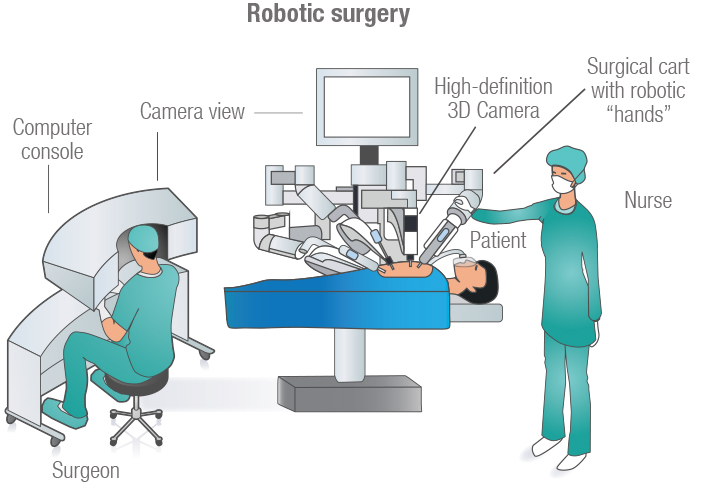
How does robotic surgery work?
In the robotic surgery, camera and other ports are placed as usual. Then robot’s arms are connected to the camera and the instrument (docking). The surgeon sits at a console nearby where they can see the surgical site in high-definition 3D magnified view.
The surgeon operates the robot with his hands and the robotic arms duplicates the surgeon’s movements (master and slave relationship). The surgeon is always in control of the robot. It only does what the surgeon directs it to do and can’t make decisions on its own.
The current Robotic surgery system has been around since 1990.
What are the pros and cons of robotic surgery?
Compared to conventional surgery, robotic surgery is more precise and exact. It gives the surgeon more control and range of motion. Robotic arms can pivot 360 degrees and reach out-of-the-way areas of the human body. Before robotic surgery, some operations were challenging or even impossible to do.
With 3D viewing, they can also see the surgical site more clearly, even microscopic structures.
This means less impact on your body and the discomfort after the operation is also less.
Other advantages of robotic surgery include:
- Less pain
- Less bleeding. May be better on patients who are on blood thinners.
- Faster healing
- Faster return to daily activities
- Better overall quality of life after surgery
Like straight stick laparoscopic surgery, there’s a chance of infection and other problems. Robotic surgery is also more expensive and takes longer to set up compared to typical surgeries.
WHAT CONDITIONS CAN ROBOTIC SURGERY TREAT?
Robotic surgery is used to treat a wide range of surgical conditions. It is especially helpful for
Abdominal wall Hernia It avoids use of stapler to fix the mesh in hernia and hence causes less pain.
Hiatus hernia and Achalasia. Robotic surgery is helpful as gives more magnified and in depth view of the hiatus.
Bariatric surgery: Sleeve gastrectomy and Gastric bypass roux en Y. Robotic view is superior to laparoscopic view.
Colon and rectum surgery
Biliary tract including gall bladder removal
Oesophagus, stomach, liver and pancreas and
Oher complex surgeries.
TECHNOLOGY BREAKTHROUGHS
Many hospitals around the globe now use robotic surgery to treat a broad spectrum of medical conditions. More and more hospitals are acquiring this type of technology due to increasing demand.
Researchers and companies continue to make smaller and more lightweight robotic surgery prototypes, along with new training programs for safer surgeries. Over the years, robotic surgery systems have become more streamlined and comfortable for doctors to use and the technology that powers these systems continues to improve. They have upgraded features like near-infrared technology and enhanced 3D cameras, which supply views that are magnified by 10 times.